Objectives
- Identify common causes of speech and language delays.
- Describe the importance of the brain in speech and language development.
- Describe what an IFSP and IEP are and the role of an early care and education professional.
- List at least 2 interactions to support language development.
- List at least 3 ways to support language development in an early care and education program.
Why is it important?
According to the University of Michigan Health System, delayed speech or language development affects 5 to 10 percent of preschool-aged children. Early childhood is the time when children are best able to learn language. This is also the time that families, early childhood professionals, and other close to children are best able to spot potential concerns and provide support to children.
Causes of Speech and Language Delays
A few causes of speech and language delays:
- Autism
- Cerebral Palsy
- Oral Impairment
- Hearing Loss
- Expressive and Receptive Language Disorders
- Intellectual Disabilities
- Selective Mutism
- Stuttering
Brain Development and Language
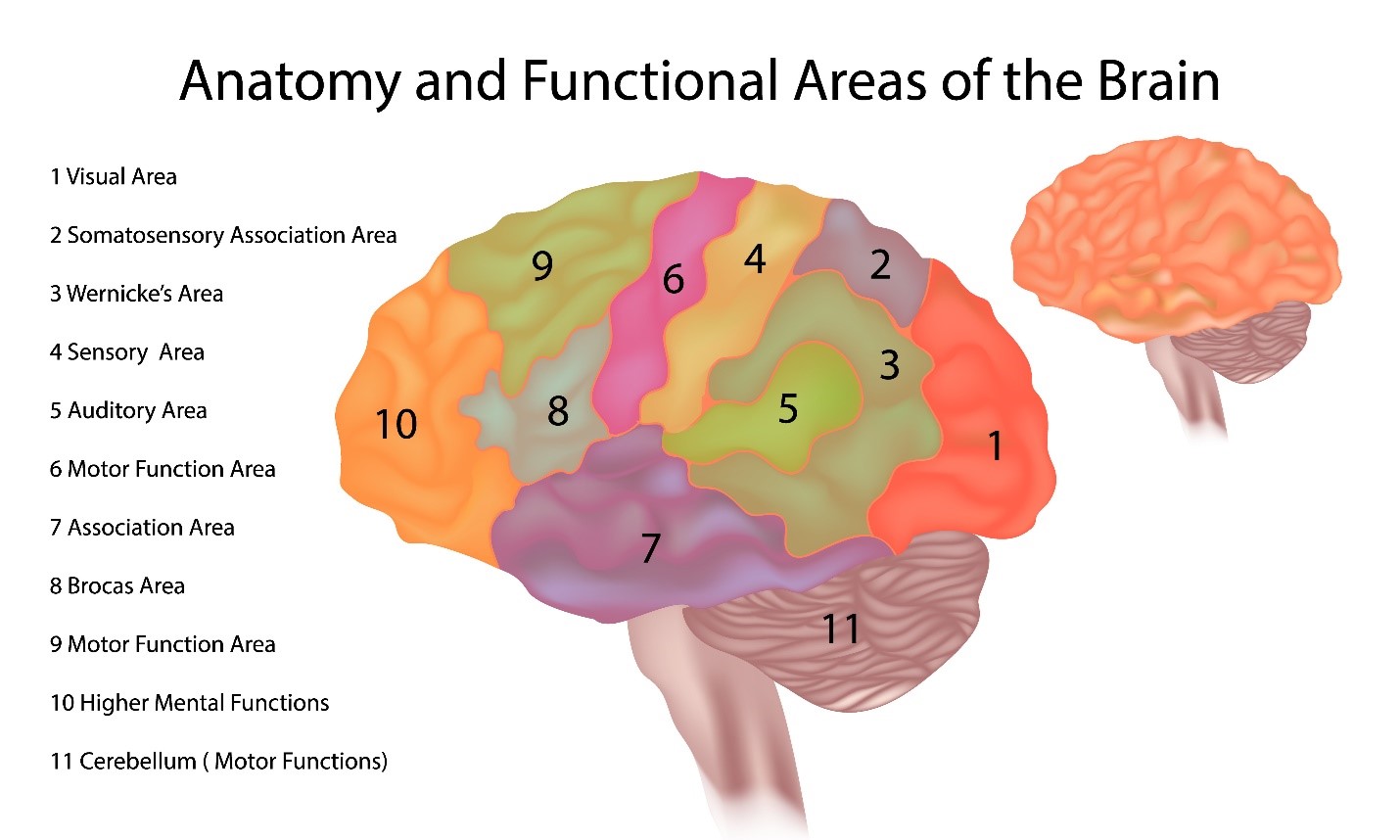
Wernicke’s Area
Important for comprehending speech sounds and for the center of language comprehension. Damage to this area of the brain could cause Wernicke aphasia (any disorder that affects how you communicate). Someone with Wernicke aphasia can speak fluently and use long sentences, but their speech may not make sense.
Broca’s Area
Involved in speech production. Damage to this area can result in Broca’s aphasia, in which individuals understand language but have difficulty articulating or speaking.
Early Interactions and Importance to Language Development
Serve and Return
- Share the Focus
- Support and Encourage
- Name It
- Take Turns
- Practice Endings and Beginnings
Learning through imitation
Children learn many skills through imitating adults and other people in their lives. Language is one of the most important of these skills. As you talk, look at the child so that they can not only hear what you say but also see how your mouth moves as you form different sounds.
Parentese
Parentese is not baby talk. Baby talk is using made-up words and incorrect grammar.
Parentese is:
- Speaking at a higher pitch.
- Speaking slow and clear.
- Elongating vowels.
- Exaggerating facial features.
- Using a variety of tones.
- Using simple sentences.
- Using correct grammar.
Joint Attention
Through joint attention, children learn:
- how to share their interests with others.
- the enjoyment that comes from having back-and-forth interactions.
- the words that match whatever has caught their attention when adults describe what they are focused on at that moment.
Early Language Learning
During the first 3 years of a child’s life, the brain is developing rapidly. This is an intensive time for speech and language development.
An infant’s first communication is when they learn that crying will bring food and comfort. They can also recognize the sounds of important things in their environment, like a parent’s voice. Most children will recognize the basic sounds of their native language by 6 months of age.
It is always important to remember that children will develop at their own pace. You can’t compare two different children to each other (“JoJo is able to speak now, why can’t Peter?”). Development will follow a path, but how long a child takes to travel that path will vary. “Typical” development refers to what is typical for most children, but children can be ahead or behind this timeline. Being behind does not always mean there is a developmental delay. It can be a good reason for a conversation and a closer look at the child’s development.
Moving From Listening to Speaking
Multilingual Language Development
Most children exposed to two or more languages go through certain stages:
- Home Language Use – Child uses their home language
- Nonverbal Period – The child may speak rarely or use other ways to communicate because they realize their home language is not understood by those around them. For example, a child speaks Spanish but the children and adults at their child care speak only English.
- Telegraphic speech – During this stage young children use phrases they have heard from others, sometimes not completely understanding the whole meaning of the words they use and mixing the two languages together.
- Productive Language – the child uses his or her own phrases that start simply but as they feel more confident with become longer and more complex.
ABCs of IFSPs and IEPs
What is an IFSP?
An Individualized Family Service Plan (IFSP) is used with families who have children, birth to 3, with a delay or disability who need specialized services and supports. Most children with an IFSP participate in the Kentucky Early Intervention System (KEIS), which was formerly known as First Steps.
Components of an IFSP
- Natural Environments/Settings
- Present Levels of Development
- Goals
What is an IEP?
An Individualized Education Program (IEP) is used to design an educational program of supports and services to help a child aged 3 to 21 be on the same level as their peers. It can be used in all early care and education settings, including child care, public preschool, and elementary school.
What is included in an IEP?
- Present Levels of Academic Achievement and Functional Performance
- Measurable Annual Goals
- Specifically Designed Instruction
- Supplementary Aids and Services
How Can Early Care and Education Professionals Help?
- Practice Serve and Return
- Use Continuous Phonation
- Monitor Development
- Developmental Monitoring
- Developmental Screening
- Developmental Evaluation
- Share Tips with Families.
- Recommend Developmental Monitoring and Screening
- Share Resources
- Empower Families
- Ask Questions
Resources
- 5 Steps for Brain-Building Serve and Return
- 8 Early Signs of Autism
- 12 Ways to Support Language Development for Infants and Toddlers
- Activities to Encourage Speech and Language Development
- CDC’s Milestone Tracker App
- Developmental Monitoring and Screening
- Expressive Language Delays: Everything You Need to Know
- Hearing and Communicative Development
- Hearing Loss: How It Affects Communication
- Intellectual Disabilities
- Kentucky Assessment Guide
- Kentucky Early Childhood Standards
- Learn The Signs Act Early
- Parentese Dictionary
- Receptive Language Delays: The No. 1 Overlooked Problem in Late Talkers
- Reinforcing Language Skills for Our Youngest Learners
- Selective Mutism
- Speech and Language Disorders Among Those with Cerebral Palsy
- Strategies for Working with Preschool Children with Language Delays
- Stuttering – Symptoms and causes – Mayo Clinic
- Supporting Language: Culturally Rich Dramatic Play
- What is Imitation and Why is it Important?
- What You Should Know About Oral Motor Dysfunction
- Why Imitation in Early Childhood is Crucial
References
- American Speech-Language-Hearing Association. (N.D.) Spoken Language Disorders. Retrieved December 1, 2023, from https://www.asha.org/practice-portal/clinical-topics/spoken-language-disorders
- Barnes, A. (2022, February 15). How- and Why- to Speak “Parentese” with Your Baby. Expressable. https://www.expressable.com/learning-center/babies-and-toddlers/how-and-why-to-speak-parentese-with-your-baby
- Britannica, T. Editors of Encyclopedia (2020, March 10). Wernicke area. Encyclopedia Britannica. https://www.britannica.com/science/Wernicke-area
- Britannica, T. Editors of Encyclopedia (2020, March 10). Broca area. Encyclopedia Britannica. https://www.britannica.com/science/Broca-area
- Buzz60. (2020, February 4). ‘Parentese’ is the new baby talk that will help your baby develop speech. USA Today. https://www.usatoday.com/videos/life/parenting/2020/02/04/parentese-new-scientifically-approved-baby-talk-build-speech/4653619002/
- Cedars Sinai. (N.D.) Selective Mutism. Retrieved December 1, 2023 from https://www.cedars-sinai.org/health-library/diseases-and-conditions—pediatrics/s/selective-mutism.html
- Center for the Developing Child. (N.D.) Serve and Return. Harvard University. Retrieved December 1, 2023, from https://developingchild.harvard.edu/science/key-concepts/serve-and-return/
- Baum, S. (2023, March 2). 5 Stages of Language Acquisition. NOALA. https://www.noala.co/blogs/child-language-acquisition
- Beeman, K. and Urow, C. (2013). Teaching for Biliteracy: Strengthening Bridges between Languages. Philadelphia, PA: Caslon Publishing. Retrieved from https://www.teachingforbiliteracy.com/wp-content/uploads/2017/06/Description-of-Second-Language-Acquisition-Stages-for-Young-Sequential-Bilinguals.pdf
- De Pietro, M.A. & Minnis S. (2017, August 4). Language Delay. Healthline https://www.healthline.com/health/language-delay
- Early Childhood Learning & Knowledge Center. (2022, July 8) Developmental Screening for Children Ages Birth to 5. https://eclkc.ohs.acf.hhs.gov/child-screening-assessment/article/developmental-screening-children-ages-birth-5
- Ekart, K. (2020, February 3). Not just ‘baby talk’: Parentese helps parents, babies make ‘conversation’ and boosts language development. UW News. https://www.washington.edu/news/2020/02/03/not-just-baby-talk-parentese-helps-parents-babies-make-conversation-and-boosts-language-development/
- Hartnett, J. (2022, March). Delayed Speech or Language Development. Kids Health. https://kidshealth.org/en/parents/not-talk.html
- Hoecker, J. (2023, March 4). Should I be concerned that my 2-year-old doesn’t say many words and is hard to understand? Mayo Clinic. https://www.mayoclinic.org/healthy-lifestyle/infant-and-toddler-health/expert-answers/toddler-speech-development/faq-20057847
- Introduction to Language Communication. (N.D.) Intellectual Disabilities. Vanderbilt University. Retrieved December 1, 2023 from https://my.vanderbilt.edu/speds2430/2020-topics/intellectual-disabilties/
- Kentucky Commission on the Deaf and Hard of Hearing. (N.D.). Hearing Loss Fact Sheet [Infographic]. Kentucky Commission on the Deaf and Hard of Hearing. Retrieved December 1, 2023. https://www.kcdhh.ky.gov/oas/factsheets/KCDHH-HearingLoss.pdf
- Kuhl, P. (2010, September 9) Brain Mechanisms in Early Language Acquisition. Neuron, 67(5):713-27. doi: 10.1016/j.neuron.2010.08.038
- KYSPIN. (N.D.). Individualized Education Program (IEP) [Infographic]. Retrieved January 19, 2024 from https://www.kyspin.com/wp-content/uploads/2022/03/IEP-Infographic-KY-SPIN-Aetna-892.pdf
- Larrazabal, M. (N.D.) Speech and Language Disorders Among Those with Cerebral Palsy. Better Speech. Retrieved December 1, 2023 from https://www.betterspeech.com/post/speech-and-language-disorders-among-those-with-cerebral-palsy#viewer-dtqdc
- Learn the Signs. Act Early. (2023, April 13). Developmental Screening. Centers for Disease Control and Prevention. https://www.cdc.gov/ncbddd/actearly/screening.html
- Lowry, L. (N.D.) Paying Attention to Children’s Joint Attention. The Hanen Centre. Retrieved December 1, 2023 from https://www.hanen.org/Helpful-Info/Articles/Paying-Attention-to-Childrens-Joint-Attention.aspx
- Mayo Clinic. (2023, September 28). Cerebral Palsy https://www.mayoclinic.org/diseases-conditions/cerebral-palsy/symptoms-causes/syc-20353999
- Mayo Clinic. (2021, June 5). Stuttering. https://www.mayoclinic.org/diseases-conditions/stuttering/symptoms-causes/syc-20353572
- National Institute on Deafness and Other Communication Disorders. (2020, April). Autism Spectrum Disorder: Communication Problems in Children. National Institute of Health. https://www.nidcd.nih.gov/health/autism-spectrum-disorder-communication-problems-children
- National Institute on Deafness and Other Communication Disorders. (2022, October 13). Speech and Language Development Milestones. National Institutes of Health. https://www.nidcd.nih.gov/health/speech-and-language
- Office of Special Education & Early Learning. (2023). Guidance for Individual Education Program (IEP) Development. https://www.education.ky.gov/specialed/excep/forms/Documents/IEP_Guidance_Document.pdf
- OpenAI. (2024). ChatGPT (3.5) [Large language model]. https://chat.openai.com
- UC Irvine. (N.D.) Receptive and Expressive Language Delays. Children’s Hospital of Orange County. Retrieved December 1, 2024 from https://www.choc.org/programs-services/rehabilitation/frequently-asked-questions-receptive-expressive-language-delays/