- Describe dyslexia and how it can impact children.
- List at least 3 resources to support children with dyslexia.
- List at least 3 resources to support families and teachers.
- Define IEP, its purpose, and the potential role of after-school teachers.
A plan that gives children accommodations to meet the needs of children with special needs. A 504 plan applies not just to education but can also apply to employment. It is not a legal document but a written plan that can be used throughout the lifespan for education and employment.
A learning disability that impairs reading ability. This can include reading and spelling of words.
A learning disability that affects handwriting, it is a letter-level language impairment that can affect spelling as well.
A learning disability that affects handwriting, it is a letter-level language impairment that can affect spelling as well.
A written legal document that maps or lays out a program of special instruction, supports, and services to children in school to support their educational needs.
A law that makes available a free appropriate public education (FAPE) to children with disabilities in public education. It ensures special education and related services to eligible children.
Differing in mental or neurological function from what is considered typical or normal.
What happens when our brains receive information, how it records it, and stores it.
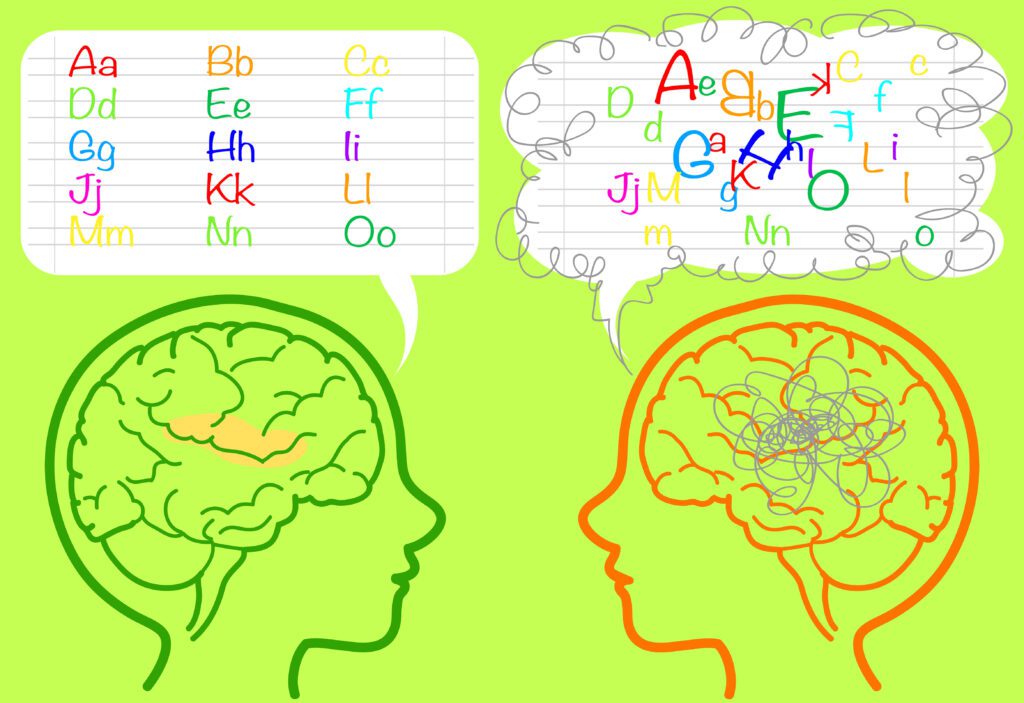
To be an efficient reader, you must have a knowledge of the connection between letters, sounds, and meaning. Dyslexics will typically struggle with the letter-sound part of reading and decoding words.
Decoding skills include being able to:
- Segment – separate the sounds in a word
- Blend – put the sounds together to form a word
- Chunk – recognizing familiar word parts (kn, sh, ch)
Dyslexia is sometimes missed in children for various reasons.
- Lack of Awareness
- Normal Variability
- Good Adaptive Skills
- Stigma and Shame
- Late Identification
- Teacher Training
Common signs of dyslexia in elementary-aged children
- Has trouble sounding out words and separating individual sounds in words. Does not understand how they come apart.
- Often confuses similar-looking letters (b, d, p, q).
- Often confuses letters that sound similar (d/t; b/p; f/v).
- Has trouble spelling.
- Does not recognize common (sight) words.
- Unable to sound out simple words like “cat,” “dog,” and “nap”.
- Trouble learning letter names and remembering their sounds.
- Struggles with common and familiar words, especially without pictures.
- Substitutes words when reading aloud – saying “house” instead of “home”. Or “puppy” instead of “dog” on an illustrated page with a dog.
- Difficulty blending sounds together to make a word.
- Trouble remembering spelling rules and how words are spelled.
- Skips or confuses small words when reading aloud, like “for” and “of”.
- Difficulty in explaining what happens in a story or answering key details about the story.
- Makes the same mistakes frequently – like reversing letters.
- Spells words correctly and incorrectly in the same activity.
- Avoids reading or gets frustrated when asked to read.
- Family history of reading problems, dysgraphia, or dyscalculia.
Strengths commonly associated with individuals with dyslexia:
- Creativity
- Spatial Reasoning
- Critical Thinking
- Strong Visual Memory
- Resilience
- Innovation
- Excellent thinking skills
- Focus Areas
An IEP is a written document that outlines the educational plan for a child with a disability. They are developed through collaborations among parents, teachers, other professionals, and sometimes the student. The purpose of an IEP is to provide specialized instruction, support services, and accommodations to meet the individual child’s needs.
IEPs are mandated by the Individuals with Disabilities Education Act (IDEA). It is a key tool to ensure that children with disabilities receive appropriate support and opportunities for academic success.
A medical diagnosis does not automatically mean a child will have an IEP. A child must fall into one or more disability categories and have an evaluation to determine their eligibility. The disability must cause an “adverse effect” that will impede educational performance and cause the child’s performance to be below the level of other kids their age. There must be a need for specifically designed instruction and related services.
An IEP will address:
- Present Levels of Academic Achievement and Functional Performance (Present Levels)
- Measurable Annual Goals
- Specifically Designed Instruction
- Supplementary Aids and Services
- Support for School Personnel
A 504 plan gets its name from being Section 504 of the Rehabilitation Act of 1973. To qualify for a 504 plan, a child needs to have a physical or mental impairment that substantially limits a major life activity, have a record of such an impairment, or be regarded as having such an impairment. The disability can be lifelong or temporary (i.e., in a wheelchair while recovering from an injury).
504 plans will include a who, what, where, when, and why of accommodations.
- Who – the teacher or other school staff who will be implementing the accommodation.
- What – the accommodation that will be provided.
- Where – location(s) of accommodation.
- When – the timing of the accommodation, or when during the day it will occur.
- Why – what is the purpose of the accommodation, what will it support for the child.
Some examples of things that might be included in a 504 plan.
- Modifications to the environment:
- Assistive Technology:
- Adaptation to the Curriculum:
- Flexible Schedule
- Extra Support:
- Behavioral Support:
Know what accommodations are on each child’s IEP. Do not assume that multiple children will have the same accommodations.
Understand that reading for a child could be reading by sight (the child reads the text) or ear (the child listens to someone read the text).
When helping read words or text, use continuous phonation, sound the word out by blending sounds together. Do not use bouncy speech – bounce between each sound the letter makes.
Provide games and activities that encourage sound awareness and letter formation. Also include books at all levels to encourage readers of all levels to visit the library center. If you use computers or tablets in your program, add some educational computer games that support literacy. You might even be able to take the concepts behind some of these games and turn them into physical games to play.

According to the National Center on Improving Literacy, the science of reading focuses on teaching based on 5 big ideas of how to teach children to read.
- Phonemic Awareness – the ability to identify and play with individual sounds in spoken words.
- Phonics – understanding how letters and groups of letters link to sounds, form letter-sound relationships, and spelling patterns.
- Fluency – the ability to read words, phrases, sentences, and stories correctly, with enough speed and expression.
- Vocabulary – knowing what words mean, how to say them, and how to use them correctly.
- Comprehension – the ability to understand what you are reading.
This is different from the whole language approach, which focuses more on reading whole words, with an emphasis on meaning. Books that use a whole-language approach will include a lot of memorization and repeated words (to aid memorization).
It focuses more on reading whole words with an emphasis on meaning. Most books that use a whole language approach will have a lot of memorization and repeated words (to aid in memorization). While a typically developing child could learn to read using this approach, a struggling reader will have difficulty learning to read.
- Bookshare www.bookshare.org
- International Dyslexia Association (IDA) https://dyslexiaida.org
- International Dyslexia Association – Kentucky (IDA Kentucky) https://www.facebook.com/KYINTERDYS/
- Kentucky Special Parent Involvement Network (KY-SPIN) https://www.kyspin.com/
- Learning Ally www.learningally.org
- Nessy https://www.nessy.com/en-us
- Pacer Center https://www.pacer.org
- Talking Book Service https://kdla.ky.gov/Talking-Books
- Understood https://www.understood.org/
- The Yale Center for Dyslexia and Creativity https://dyslexia.yale.edu/
Approaching a conversation about potential learning difficulties with a parent requires sensitivity and open communication. Here are some steps a teacher can take when expressing concerns about a child possibly being dyslexic:
- Choose an Appropriate Setting
- Use Positive Language
- Share Observations
- Express Your Intentions
- Provide Information on Dyslexia
- Recommend Further Assessment
- Assure Support
- Be Open to Questions
- Collaborate on a Plan
- Follow-Up
Remember that your role is to support the child’s learning and development, and approaching the conversation with empathy and collaboration can help create a positive outcome. Gathering information, especially data, is very important in establishing the child’s needs related to their educational environment.
Listening to a parent who has concerns about their child possibly being dyslexic requires empathy and understanding. Here are some steps you can take:
- Show Empathy
- Active Listening
- Ask Open-Ended Questions
- Validate Their Concerns
- Provide Information
- Suggest a Professional Assessment
- Highlight Support Services
- Encourage Communication with Teachers
- Stay Positive
- Ask Schools to Do an Evaluation
Remember, the goal is to support the parent and their child through the process of addressing concerns about dyslexia. Always recommend professional assessments and involve appropriate educational professionals in the discussion.
Whether schools can assess for dyslexia does not have a straightforward answer. The answer? Yes, and no. Schools do not specifically assess and diagnose dyslexia. Both the Kentucky and Federal definitions of specific learning disabilities, as educational categories, include dyslexia. Families should ask for an evaluation in the areas of reading and writing for the educational category of specific learning disabilities (SLD).
- Adlof, S. M., and Hogan, T. (2018) Understanding Dyslexia in the Context of Developmental Language Disorders. Language, speech & hearing services in schools 49.4: 762–773.
- Calderwood, B. (2023, November 11). Decoding in Reading: Definition, Stategies, & Examples. https://study.com/academy/lesson/teaching-decoding-reading-strategies.html.
- Class Sizes. (2023, December 31). In Wikipedia. https://en.wikipedia.org/w/index.php?title=Class_size&oldid=1192843091
- Cleveland Medical Clinic. (2023, April 11). Dyslexia https://my.clevelandclinic.org/health/diseases/6005-dyslexia 4/11/2023 Cleveland Cunningham, B. (Ed.). (N.D.) Understanding dyslexia in your child. Retrieved January 19, 2024 from https://www.understood.org/articles/dyslexia-in-children
- Days with Dyslexia. (2022, August 24). Can Schools evaluate for dyslexia? [Video]. YouTube. https://youtu.be/w7FaLcyvQ4Y
- Division of Regulated Child Care. (2022). Kentucky Standards of Practice Child-Care Center Licensure: A Resource for Licensed Child Care Providers, Child Care Surveyors, and Technical Assistance Staff. [Version 7]. https://www.childcareawareky.org/wp-content/uploads/2023/02/Licensed-Child-Care-SOP-7.21.22.1.23.pdf
- Gillis, M. (N.D.) Signs of dyslexia at different ages. Retrieved January 19, 2024 from https://www.understood.org/articles/checklist-signs-of-dyslexia-at-different-ages
- Hanson, Jennifer. (N.D.) 504 Plan Kentucky. Special Education Journey. Retrieved February 28, 2024 from https://special-education-journey.com/504-plan-kentucky/
- Horowitz, S. (Ed.). (N.D.) Dyslexia in grade school: 4 signs you might see. Retrieved January 19, 2024 from https://www.understood.org/articles/dyslexia-in-grade-school-4-signs-you-might-see
- Kentucky Administrative Regulations (KAR) (2021 December 15). 922 KAR 2:120, Child-care center health and safety standards. https://apps.legislature.ky.gov/law/kar/titles/922/002/120/
- KYSPIN. (N.D.). Section 504 Plans [Infographic]. Retrieved January 19, 2024 from https://www.kyspin.com/wp-content/uploads/2022/12/504-Plans-Infographic-KY-SPIN-Aetna.pdf
- KYSPIN. (N.D.). Individualized Education Program (IEP) [Infographic]. Retrieved January 19, 2024 from https://www.kyspin.com/wp-content/uploads/2022/03/IEP-Infographic-KY-SPIN-Aetna-892.pdf
- Morin, A. (N.D.) 7 Common Myths About Dyslexia. Understood for All. Retrieved January 17, 2024 from https://www.understood.org/articles/common-myths-about-dyslexia-reading-issues
- National Center on Improving Literacy (2022). The Science of Reading: The Basics. Washington, DC: U.S. Department of Education, Office of Elementary and Secondary Education, Office of Special Education Programs, National Center on Improving Literacy. Retrieved February 28, 2024, from http://improvingliteracy.org.
- Office of Special Education & Early Learning. (2023). Guidance for Individual Education Program (IEP) Development. https://www.education.ky.gov/specialed/excep/forms/Documents/IEP_Guidance_Document.pdf
- OpenAI. (2024). ChatGPT (3.5) [Large language model]. https://chat.openai.com
- The Reading League. (N.D.) What is the Science of Reading. Retrieved February 28, 2024 from https://www.thereadingleague.org/what-is-the-science-of-reading/
- Reading Rockets. (N.D.) Target the Problem: Word Decoding and Phonics. Retrieved January 19, 2024 fromhttps://www.readingrockets.org/helping-all-readers/why-some-kids-struggle/target-problem/word-decoding-and-phonics
- Sandman-Hurley, K. (2013, July 15). What is Dyslexia? [Video] YouTube https://youtu.be/zafiGBrFkRM
- Snowling MJ, Hulme C, Nation K. Defining and understanding dyslexia: past, present and future. Oxf Rev Educ. 2020 Aug 13;46(4):501-513. doi: 10.1080/03054985.2020.1765756. PMID: 32939103; PMCID: PMC7455053.
- Shaywitz, S. & Shaywitz J. (2005). Overcoming Dyslexia (2020 Edition). Vintage.
- Wagner, R. (2018, December) Why Is It So Difficult to Diagnose Dyslexia and How Can we Do It Better? International dyslexia Association Vol 7 Issue 5