
A special thanks to the Centers for Disease Control and Prevention (CDC),Nemours, and the Kentucky Department for Public Health Prevention Branch for the content, funding, and creation of this training.
Objectives
- Understand the benefits of breastfeeding for mothers and babies.
- Explain and describe paced bottle feeding.
- Identify 2 strategies that support breastfeeding in the early care setting.
Why is breastfeeding important?
One of the most effective preventive measures a mother can take to protect the health of her infant and herself is to breastfeed. The decision to breastfeed is a personal one, and a mother should not be made to feel guilty if she cannot or chooses not tobreastfeed. The success rate among mothers who choose to breastfeed can be greatlyimproved through active support. – Surgeon General’s Call to Action to Support Breastfeeding
Breastfeeding can evoke visceral feelings for many of us. Thesepersonal feelings about breastfeeding can impact how we interact with families. However, as professional care providers, we recognize that infant feeding decisions ultimately rest with the family. The role of the care provider is to support mothers in their feeding decisions, whether she desires to breastfeed, formula feed, or a combination of both. All caregiversshould be trained to encourage and support breastfeeding families.
What are your personal feelings about breastfeeding?
How do your feelings influence your support of breastfeeding?
Reflective Activity – What do you know about breastfeeding?
True or False Breast milk contains protective antibodies that prevent infection and sickness.
True of False Infant formula does not contain many of the components that are in breast milk.
True or False Breastfeeding lowers the mother’s risk of breast cancer and type 2 diabetes.
True or False Breastfed babies are less likely to be overweight or obese later in life.
True or False The American Academy of Pediatrics recommends exclusive breastfeeding for the first six months of life.
True or False Breastfeeding supports optimal brain development.
Why breastfeed?
The American Academy of Pediatrics recommends that babies be exclusively breastfed forabout the first six months of life. This means your baby needs no additional foods (except Vitamin D) or fluids unless medically indicated. Babies should continue to breastfeed for ayear and for as long as is mutually desired by the mother and baby.
Benefits of Breastfeeding
Breastfed babies have been shown to have lower risks of many things, including:
- Ear infections
- Diarrhea
- Respiratory infections
- Meningitis
- Allergies
- Asthma
- Excema
- Diabetes
- Obesity
- Sudden infant death syndrome (SIDS)
There are numerous benefits for mom, and it lowers the risk for many things, including:
- Type 2 diabetes
- Hypertension
- Breast cancer
- Ovarian cancer
- Endometrial cancer
- Reimbursable in CACFP
- Healthier infants
- Marketing tool for families
- Foster stronger family relationships
How much breastmilk?
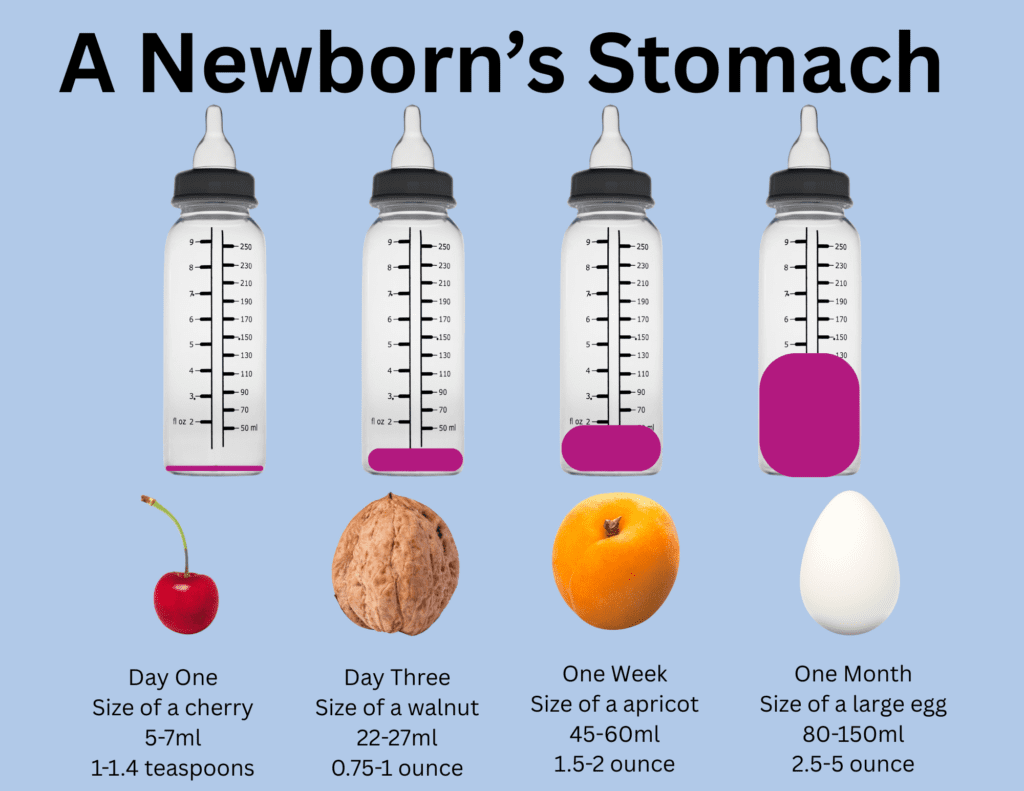
The actual size of a newborn baby’s stomach may surprise most people. The stomach size at birth corresponds to the amount of the nutrient-dense colostrum made by mothers. At day one, the capacity of the infant’s stomach is approximately the size of a cherry, around 5-7milliliters or 1-1.4 teaspoons. By day three, the infant’s stomach has grown to roughly the sizeof a walnut, measuring around 22-27 milliliters or 0.75-1 ounce. At one week, an infant’s stomach is approximately the size of an apricot, measuring around 45-60 milliliters or 1.5-2ounces. By one month of age, the infant’s stomach has grown considerably and is now thesize of a large egg, approximately 80-150 milliliters, or 2.5 to 5 ounces.
Storage of Breastmilk
Freshly expressed should be refrigerated at 39°F for up to 3 days or frozen at 0°F for up to 3 months. Previously frozen and thawed in a refrigerator – but not warmed yet should berefrigerated at 39°F for up to 24 hours and not refrozen. Previously frozen and thawed in a refrigerator, and already warmed, should be usedwithin an hour. Unused milk can be discarded or returned to the family. Per licensing regulations, bottles should be individually labeled, promptly refrigerated,covered when not in use, and consumed within one hour of being heated or removed from the refrigerator. All these precautions help ensure that the correct child receives the properfood, prevent cross-contamination, and limit the possibility of bacterial growth.
- Never microwave milk.
- Warm the milk under water or by placing it in a container of water. Bottle warmers are fine, but crockpots are dangerous.
- Temperature should not exceed 98.6 degrees Fahrenheit.
- Gently swirl milk and never shake. Shaking destroys the antibodies in the milk.
Feeding Breastmilk
- Wash your hands
- Warm bottles slowly and gently
- Test that milk is not above 98.6 degrees
- Gently swirl the milk – never shake!
- Check to make sure you have the right bottle for the right child
Feeding the Wrong Child
If a mix-up occurs, be sure to document this and notify affected families. In addition, follow the steps below. Per Caring For Our Children:
- Inform the mother who expressed the human milk about the mistake and when the
bottle switch occurred, and ask her the following questions:- When was the human milk expressed and how was it handled before being delivered to the early care and education program?
- Would she be willing to share information about her current medication use, recent infectious disease history, and presence of cracked or bleeding nipples during milk expression with the other family or the child’s primary care provider?
- Discuss the event with the parents/guardians of the child who was given another
mother’s milk.- Inform them that their child was given another mother’s expressed human milk.
- Inform them that the risk of transmitting infectious diseases is low.
- If possible, provide the family with information on when the milk was expressed and how it was handled before being delivered to the early care and education
program. - Encourage them to notify the child’s primary care provider about the situation and share any specific details they are aware of.
- Assess why the wrong milk was given and develop policies and procedures to prevent
future mistakes related to labeling, storing, preparing, and feeding human milk in the
early care and education program. Share these policies and procedures with
parents/guardians as well as the early care and education staff.
Feeding Cues
The best practice is to use responsive feeding with infants. This is when you feed babies ondemand, rather than on a clock. This method helps prevent obesity, as it allows children tounderstand hunger and fullness feelings. Using responsive feeding, children learn to eatwhen they are hungry and stop eating when they are full. For breastfeeding mothers,feeding on demand helps maintain an adequate milk supply.
Hunger Cues
- Hands move towards the face
- Opening and closing the mouth
- Sucking on the hands
- Turning the head from side to side
- Crying
- Turning red
Fullness Cues
- Turning away from the bottle nipple
- Increased attention on what is happening around them
- Keeping the mouth closed
- Saying no
- Falling asleep
Strategies for a Supportive Environment
Strategies
- Practice proper storage and labeling of breastmilk.
- Provide staff training on breastfeeding.
- Create individual feeding plans with families.
- Have a current breastfeeding/infant feeding policy.
- Communicate with families on breastfeeding.
- Provide a dedicated space for nursing.
- Provide employee support for breastfeeding staff.
- Display signage to show your support for breastfeeding.
Provide parents with current information on breastfeeding, including local support and
informational resources.
Considering the strategies, think about your program and answer the following questions.
- How can your program better support breastfeeding families?
- What challenges do you have in implementing these strategies?
Breastfeeding Spaces
Each program is different in the space available to create an area for mothers to breastfeed or pump. Creating a space supports mothers in continuing to breastfeed when they return towork or school. Some mothers are comfortable breastfeeding in the classroom, while others prefer a quiet, private space. Mothers and staff can use a breastfeeding space as a pumping area if an outlet and table are available. This breastfeeding space can be a great marketing tool for programs as you conduct tours. Breastfeeding staff should also beencouraged to use this space to support their needs.
Let’s take a moment to think about your program and spaces for breastfeeding. Answer each of the following questions. Please share this information with a supervisor to advocate for creating a space or improving one you currently have.
Identify a space in your program that could be used for a breastfeeding or pumpingmother. If your program already has a breastfeeding space think about how you canimprove the area.
- Briefly describe the space in your program. How is it currently being used?
- What modifications would you like to see?
- What support do you need to create or improve a breastfeeding space?
- From the list, what would you like to have in a breastfeeding space.
Policies
Quality child care programs have written policies and procedures in place. Some child care providers may compile this information in parent handbooks. Having written policies is a sign that your program has invested time and effort in determining how it will care for children and operate its business. Additionally, written policies and procedures help ensure that all staff, volunteers, and parents understand and follow the established guidelines.
Policies support caregivers as they define how specific aspects of care will be handled. They also outline the family’s roles and responsibilities in care. When implemented, policies support consistent care of children. You may or may not be in a position to develop policy for your program. Take a few moments to review the Kentucky Child Care Health Consultation Program sample breastfeeding policy template.
As you read, consider what you know about your program’s current practices on breastfeeding. List out two things you feel are most important to include in your program’spolicy. Consider how this might impact the breastfeeding environment at your workplace.