
Objectives
Upon completion of this course, you will be able to:
- Recognize the importance of the Kentucky Strengthening Families (KYSF) Initiative based on the research that supports the movement.
- List and explain each of the 6 Protective Factors.
- Identify family-driven, youth-driven, and strength-based implementation strategies.
- Recognize how to shift from a deficit-based, risk factor lens of working with families to a more positive lens that focuses on their strengths and skills.
- Identify how Protective Factors can support your work with children and families.
What is Kentucky Strengthening Families?
Mission
Kentucky is Strengthening Families by enhancing Protective Factors that reduce the impact of adversity and increase the well-being of children and families through partnerships among families, communities, and the state.
Vision
All Kentucky children are healthy, safe, and prepared to succeed in school and in life through resilient, supported, and strengthened families within their communities.
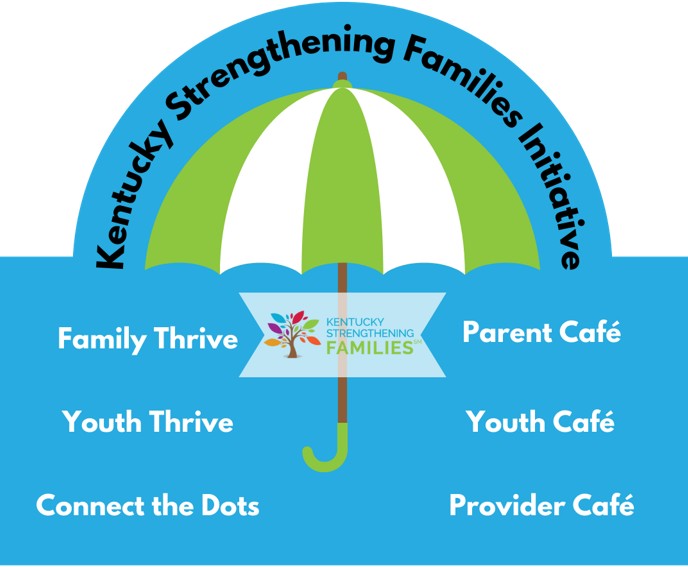
Under the Kentucky Strengthening Families Initiative, there are 6 training curricula to support the Initiative.
- Family Thrive
- Youth Thrive
- Connect the Dots
- Parent Cafe
- Youth Cafe
- Provider Cafe
Adverse Childhood Experiences (ACEs)
Adverse Childhood Experiences (ACEs) occur in childhood (ages 0-18) and involve a combination of traumatic events and environmental factors that can affect a sense of safety, stability, or bonding. ACEs are situations where children experience adversity (difficulty or crisis). ACEs could include:
- Experiencing or witnessing violence,
- Having a family member struggle with mental health,
- Substance abuse in the home, and
- Instability due to parent separation or incarceration.
Researchers Found That Adverse Childhood Experiences (ACEs)…
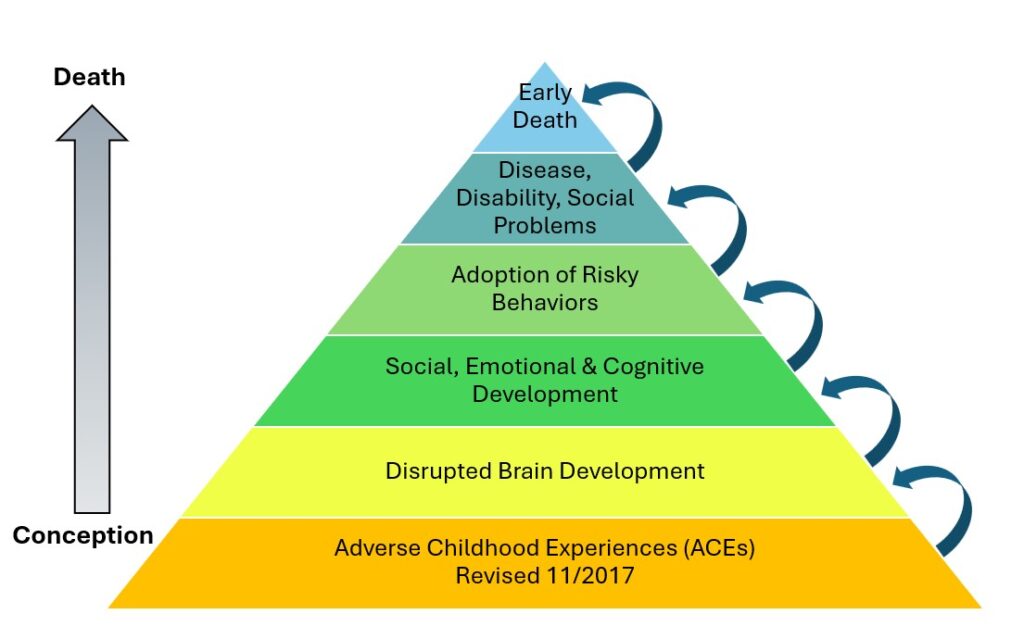
- Can lead to social, emotional, and cognitive impairment.
- This, in turn, frequently leads these individuals to adopt risky behaviors such as smoking, alcohol, and drug abuse.
- This can lead to disease, disability, and social problems.
- And ultimately, early death.
Positive Childhood Experiences (PCEs)

How can we support children who have experienced a traumatic event? In addition, how can we support children who have not yet experienced a traumatic event but might in the future?
By moving from only focusing on reducing trauma to learning how to develop resiliency starting in childhood.
Positive Childhood Experiences (PCEs) help build resilience in children, enabling them to become healthier adults. Through PCEs, children learn to trust the support of social connections, which is linked to healthy adult mental health. Children who become adults who can seek support and get access to care have improved symptoms, even if mental illness is present.
7 Positive Childhood Experiences That Help Grow Resilience
- Ability to talk with family about feelings.
- Felt experience that family is supportive in difficult times.
- Enjoyment in participation in community traditions.
- Feeling of belonging in high school.
- Feeling of being supported by friends.
- Having at least two non-parent adults who genuinely care.
- Feeling safe and protected by an adult at home.
Protective Factors and Guiding Premises
6 Protective Factors
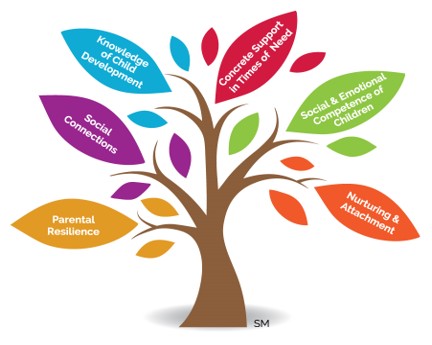
- Parental Resilience: Families bounce back in order to move forward.
Managing stress and moving forward when faced with challenges, adversity, and trauma. - Social Connections: Families have friends they can count on.
Having positive relationships that provide emotional, informational, and spiritual support. - Knowledge of Child Development: Families learn how their children grow and develop.
Understanding child development and parenting strategies that advance physical, cognitive, language, social, and emotional development. - Concrete Support in Times of Need: Families get assistance to meet basic needs.
Accessing resources that address a family’s basic needs, resulting in minimizing stress caused by challenges. - Social and Emotional Competence of Children: Families teach children how to have healthy relationships.
Establishing family and child interactions that help children develop the ability to recognize, communicate, and regulate their emotions. - Nurturing and Attachment: Families ensure children feel loved and safe.
Fostering a nurturing family environment where young children develop secure bonds with caring adults.
6 Guiding Premises
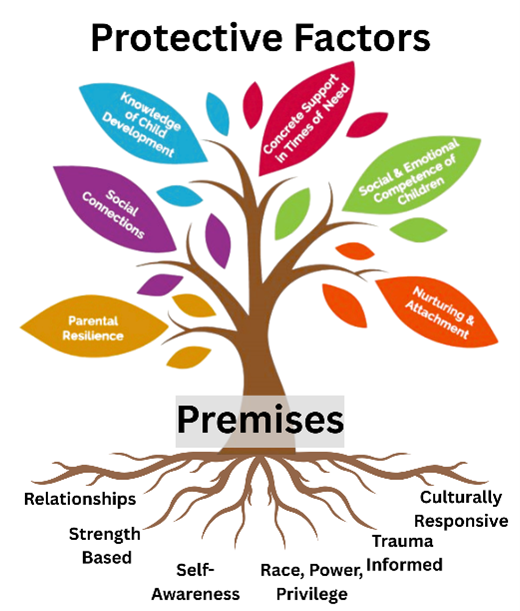
- Relationships
- Strength Based
- Self-Awareness
- Race, Privilege, and Power
- Trauma Informed
- Culturally Responsive
Families and young children are best supported by child and youth care professionals who understand and recognize the importance of self-awareness and self-care in their own professional practice. We can look at how these concepts align by thinking of the Protective Factors as the leaves on the tree and the Premises as its roots. This visual shows the connection between the Protective Factors and Premises and helps explain how the Premises lay the foundation for professionals to understand how to incorporate the Protective Factors into the work you are doing.
Risk Factors
Risk factors refer to the stressful conditions, events, or circumstances (e.g., maternal depression, substance abuse, family violence, persistent poverty) that increase a family’s chances for poor outcomes, including child abuse and neglect.
Protective Factors
Protective Factors are conditions or attributes of individuals, families, communities, or the larger society that mitigate risk and promote healthy development and well-being. Put simply, they are the strengths that help to buffer and support families at risk.
When Implementing Kentucky Strengthening Families…

Shift from focusing on the family’s deficits and risk factors to focusing on the family’s strengths and skills.
Shift from focusing on “at-risk” families to all families.
Shift from “fixing” to respecting and working with families.
Focus on making small but significant changes in our everyday actions and interactions with all families.
| Negative, Deficit-Focused Lens: | Strength-Based Lens: |
|---|---|
| A focus on a family’s deficits and risk factors. | All families have strengths and skills that are protective factors. |
| Services are only available for “at-risk families.” | All families face adversity at times, and strong relationships help buffer this (toxic) stress. |
| A belief that we are fixing families by doing “to” rather than “with.” | Families know their children best, and all families should be respected. |
| Underestimating the critical importance of children from birth to age five. | Early experiences are important because they impact, both positively and negatively, the child and family for a lifetime. |
| Because resources are scarce, programs struggle to meet all their families’ needs. | Kentucky Strengthening Families promotes these concepts through small but significant changes in everyday actions. |
What is Strengths Based? What is Youth Driven?
Strengths Based
People are best supported by service providers who focus on assets and use strength-based approaches. Being strength-based means we recognize what is going “well” and build on those strengths rather than focusing only on a person’s deficits.
Engagement and involvement improve when we focus on strengths first. This can also increase motivation to make necessary changes over time. People need to know that providers are their advocates and want to help them succeed.
When people are in the driver’s seat of their own goals, they are more successful in achieving them. They have the buy-in.
Youth Driven
People attach to people, not programs.
Active listening is essential when building relationships.
Relationships are the defining factor of the success of our programs. They are essential to creating programs that change people’s lives. It is important to build a relationship with people by discussing their interests and backgrounds before addressing any issues or problems.
How to Implement Strengths-Based, Youth-Driven Activities
When implementing activities, consider what might work well with your program and the families you serve. Remember, you have a great resource at your fingertips: the families you serve! Don’t forget to involve families in determining what activities to implement. When planning activities with staff, families, and youth, it is important to ensure that the information will benefit them.
Make a Plan
Now that you have learned more about implementing a plan to support families, it’s time to make a plan!
Step 1: Identify the Protective Factor
Go back through the 6 Protective Factors and identify which Protective Factor you would like your goal to be related to.
- Parental Resilience
- Social Connections
- Knowledge of Child Development
- Concrete Support in Times of Need
- Social and Emotional Competence of Children
- Nuturing and Attachment
Step 2: Identify Your Goal
After determining the Protective Factor, identify your goal. Check whether your goal is strength-based, family-driven, or youth-driven.
Need some ideas? Here are a few examples.
- Protective Factor: Parental Resilience
Create a large mural using sticky notes where parents and staff can share their self-care strategies. - Protective Factor: Social Connections
Host an annual Parent Event on the playground at the beginning of the school year. - Protective Factor: Knowledge of Child Development
Provide a brochure rack addressing typical behavior issues in the front lobby. - Protective Factor: Concrete Support in Times of Need
Ask families or youth what they are struggling with and provide information on resources. - Protective Factor: Social and Emotional Competence of Children
Include links to social and emotional websites in paperwork sent home to families. - Protective Factor: Nurturing and Attachment in Action
- Provide resources for free family events, family meal programs through extension, etc.
Step 3: Decide if the Goal is the Best for Your Program
Questions to ask yourself:
- Is this family-informed and family-driven (or staff-driven)?
- Is this strength-based (or deficit-based)?
- Do you build the family’s skills and support their role as experts? Or are you just doing a knowledge dump?
- Who are your community partners?
- What resources could you connect families to?