
Objectives
The information in this module will equip providers to promote quality practices in the classroom by using developmentally appropriate furnishings and materials. This training will offer evidence-based information and short vignettes to demonstrate intentional teaching strategies when engaging young children in play.
Early Care and Education professionals need to have specific knowledge, competencies, and characteristics to work effectively with very young children. This training promotes Kentucky’s Early Childhood Core Content, specifically addressing the areas of Learning Environments and Curriculum. The competency speaks to how positive interaction with age-appropriate materials fosters a child’s physical, cognitive, communicative, creative, and social development.
- Identify age-appropriate materials for preschool children at varying skill levels.
- Understand how materials support preschoolers’ cognitive, physical, and social-emotional skills.
- Design exciting interest centers that invite very young children to interact safely with materials.
Essential Elements to Support Quality
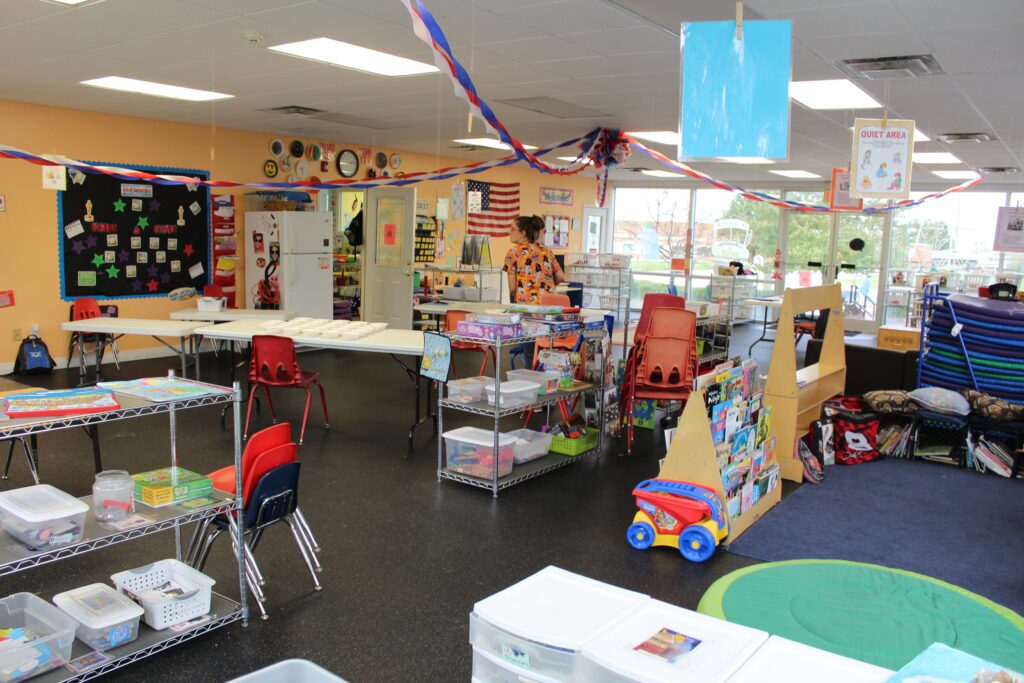
All early care settings should include the following essential elements to support and promote quality.
- Ensure all children are healthy and safe.
- Ensure all children have the opportunity to interact with peers, adults, and the community and build relationships.
- Ensure all children have a variety of experiences that engage them and allow them to use age-appropriate, hands-on materials within the learning environment.
School-aged children are naturally drawn to learning environments that are inviting, exciting, and that support socialization among peers. Your role is critical because YOU determine the design of environments specific to school-aged care, and the experiences there that appropriately engage children.
You may ask: How do I arrange an effective learning environment for school-aged settings? What materials will I need? How can I provide active learning for this age group
To help you create a positive learning environment for school-aged children, we will examine four key components to help you set the stage for learning. We will describe how to design:
- Developmentally and individually appropriate school-aged environments.
- Activities, learning experiences, and routines.
- Share strategies that support and foster positive social behaviors within a safe setting.
Sketching Your Preschool Classroom
Sketch your room’s arrangement using the classroom sketch template provided here or in your handout. Include the interest areas you currently have available for the age group you serve.

Enhancing Playspaces
We need to consider opportunities to support:
- various skill levels,
- interests, and
- developmental characteristics of children aged 6 to 12 years.
Keep in mind that during an average school day, children:
- are hard at work completing tasks and following directions,
- spend a substantial part of their day sitting for long periods of time, and
- spend time building relationships within a structured classroom setting, including small-group work, lunch, and recess.
Therefore, an appropriate environment for school-aged children would not look like a typical classroom. In contrast, a well-designed after-school setting would promote the development of social skills, inspire and motivate learning, and foster healthy personal care behaviors within a safe and inviting atmosphere.
Whether creating or re-creating your school-aged space, it is important to consider supervision, aesthetics, organization, and the developmental needs of all children who use it.
Revisiting your Sketch
Review the areas you have highlighted and note what you would like to change.
Friendships allow children to broaden their horizons beyond the family unit, begin to experience the outside world, form a self-image and develop a social support system.
American Academy of Pediatrics, 2004
Supporting the School Age Setting
To foster a positive environment, the classroom should be child-centered with a balance of teacher-directed and child-directed activities that include daily opportunities for independent learning and cooperative play. In a quality school-aged setting, there are appropriate materials, inviting spaces, and teachers with a warm, caring approach. Children and teachers alike show enthusiasm for learning, mutual respect, and positive communication throughout the day!
Teachers can use play experiences to increase a child’s ability to persevere, encourage creativity, and recognize when to take initiative; characteristics that will follow them into adulthood.
Understanding basic child development and expectations for school-aged children allows you to choose materials and activities that meet the unique needs and interests of individual children. The role of the teacher is to provide school-aged children with a variety of choices within inviting interest areas such as construction, books, music, and dramatic play.
The design of the school-aged environment offers a baseline for a supportive learning atmosphere. Embedding activities and meaningful play experiences is the next step for implementing quality practices.
Quiet Spaces
To create an inviting book area, teachers need to offer:
- A comfortable place for school-aged children to engage and explore books,
- Appropriately soft furnishings,
- Child accessible bookshelves, and
- A variety of books to meet the needs of various reading levels for the children in your care.
Teachers can also promote a desired interest in reading by sharing their favorite stories and providing opportunities to visit the library, and by offering activities that allow children to create and write their own stories and poems.
Building and Constructing
Research suggests that block play provides a wide variety of learning opportunities, including possibilities to help children develop the spatial reasoning skills important for later STEM learning.
Kersh, Casey, & Young 2008
At the building and construction center, school-aged children can improve their large- and small-motor skills as they begin building more complex structures that require balancing, maintaining self-control, and practicing hand-eye coordination. Further, school-aged children who work together in this interest area begin to practice negotiation, follow the rules, share ideas and insights, and view the world from other points of view.
School-aged children expand their vocabulary by using words to describe types of structures, shapes, and buildings. Professionals can prompt children by encouraging them to describe their structures and their building process, and to write stories about the structures they create.
Dramatic Play Matters
Children use dramatic play to explore their own thoughts and feelings.
Barb Harvey -Parents, Teachers, and Advocates, Inc.
Pretend play is an excellent way for school agers to use children use their imagination and develop creativity. Children act out what they have seen and experienced in their world. When school-aged teachers offer this exciting interest area, school agers have a way to appropriately and safely express their feelings; they can act out feelings that they may otherwise not be able to communicate.
Consider offering opportunities for school agers to develop drama/theater productions, including writing the script, creating props, and designing the scene set. Provide props that are interesting. Creating supportive role-play through pretend play helps enhance self-regulation and is a method for developing conflict-resolution skills.
Experiencing Art
When school age children are given opportunity to paint, draw, mold and create, researchers discovered strong connection between childhood exposure to arts and positive outcomes later in life.
National Coalition for Core Arts Standards 2012
Teachers should ensure there is an ample supply of materials available and accessible to extend opportunities for creative expression through the art area. Providing plain paper, pencils, crayons, and markers is a start. To expand their creative skills, teachers should also make a variety of finger paints, watercolors, and tempera paints available.
The teacher’s role is to celebrate a child’s artwork. Hanging their creations on the wall or displaying them on a shelf nurtures a child’s self-image and sends the message that their creation is important. Also, teachers can extend their learning by inviting community members to teach children specialized skills, such as pottery, weaving, or sculpting.
Creating Exploration through Science & Math
In order for children to succeed in this fast paced, technological society, students need to develop their capabilities in science, technology, engineering and math to levels much beyond what was considered acceptable in the past.
National Science Foundation, 2017
Teachers need to offer hands-on science and math activities that encourage exploration and foster innovative thinking among school-aged students. These types of activities help school agers develop critical thinking and observation skills.
Examples can include providing activities and materials that support learning about the earth, the human body, plants and animals; equipping the interest area with magnifying glasses, magnetic numbers and letters, scales, three dimensional models of the earth or solar system to support meaningful learning experiences; placing unique and interesting natural objects within the center and add sand, water, rocks, and shells; or providing an aquarium, hermit crab, iguana, etc. for the class to observe and care for daily.
Quality science and math activities encourage school-aged children to explore and observe. When professionals successfully guide children in these activities, children learn to ask thought-provoking questions and begin to connect with their world.
Making Music
Research revealed that children advanced in language and reading skills and had improved critical thinking and problem solving when they were offered frequent musical experiences.
USC Brain and Creativity Institute, 2016
Teachers should offer various types of open-ended music opportunities for children to explore and enjoy. Create this particular interest area with enough space for children to move and participate freely. Make music available to children as much as possible throughout the schedule.
- Provide a variety of age-appropriate musical instruments.
- Introduce different genres of music
- Include books about musicians and composers.
- Bring in special guests to share their talents with the children.
- Offer opportunities for children to write and compose their own music, or even record their own song and dance.
Inclusive Classroom Settings
The desired results of inclusive experiences for children with and without disabilities and their families include a sense of belonging and membership, positive social relationships and friendships, and development and learning to reach their full potential.
NAEYC Position Statement, 2009
School-aged children learn by modeling what they see from adults. It is critical for school-aged professionals to design inclusive classroom settings and demonstrate respect for all children in their care.
The school-aged setting should not only be clean and safe, but also provide a warm and friendly atmosphere for both children and adults. Teachers should provide age-appropriate materials and activities that embrace a multicultural perspective. The interest areas, books, toys, dolls, instruments, music, and pictures should display an appreciation for individual differences, including religion, race, abilities, and age.
Professionals who guide school-aged children in learning about our diverse world in a supportive way help facilitate positive social skills and encourage individual respect for others.
Establishing Routines and Transitions
Routines and transitions within the schedule provide guidance, support instruction, and establish a sense of security for these young adolescents.
Vicki Garrett, Squires Elementary School
Teachers need to be aware of the importance of providing daily routines and transitions in the school-aged setting. As teachers, when we establish consistent routines, we also provide valuable guidance and instruction.
To ensure the effectiveness of personal routines, school-aged professionals need to provide transitions between activities during after-school care. Implementing smooth transitions decreases negative behaviors that may arise when moving from one event to another within the schedule. School-aged children gain a sense of security in their environment through routines and transitions; they become familiar with what they know, what to expect, and when to expect it.
Summary and Wrap Up
Children seek relationships and thrive with positive adult direction and attention.
Sheryl Stice, Summit Christian Academy
If you would like free technical assistance with your room arrangement, contact your Child Care Aware Quality Coach. If you have any further questions about this online module or course credit, contact Inspire Learning Hub.