
Objectives
The information in this module will equip providers to promote quality practices in the classroom by using developmentally appropriate furnishings and materials. This training will offer evidence-based information and short vignettes to demonstrate intentional teaching strategies when engaging young children in play.
Early Care and Education professionals need to have specific knowledge, competencies, and characteristics to work effectively with very young children. This training promotes Kentucky’s Early Childhood Core Content, specifically addressing the areas of Learning Environments and Curriculum. The competency speaks to how positive interaction with age-appropriate materials fosters a child’s physical, cognitive, communicative, creative, and social development.
- Identify age-appropriate materials with varying skill levels to support infant/toddler play
- Understand how materials supports cognitive, physical, and social-emotional skills of infants and toddlers
- Design exciting interest centers that invite very young children to interact safely with materials
Essential Elements to Support Quality
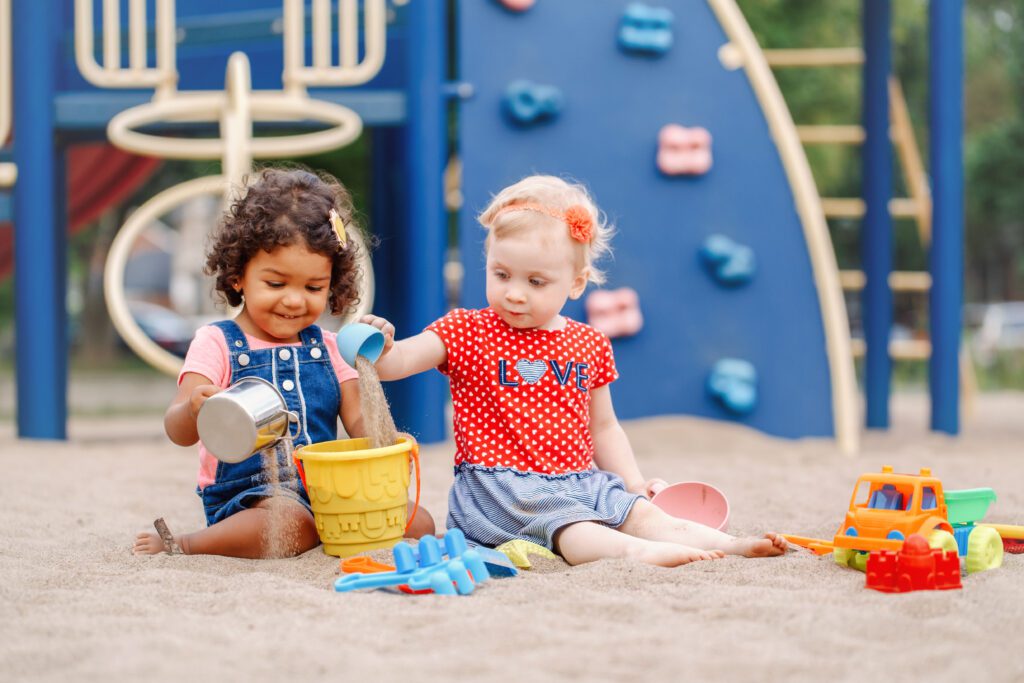
All early care settings should include the following essential elements to support and promote quality.
- Ensure all children are healthy and safe.
- Ensure all children have the opportunity to interact and build relationships with peers, adults, and the community.
- Ensure all children have a variety of experiences to engage and use age-appropriate, hands-on materials within the learning environment.
Your role is critical because YOU determine the classroom design and the kinds of experiences children will have while in your care. You may ask: How do I arrange an effective learning environment for infants and toddlers? What materials will I need? How can I provide active learning for this age group?
To help you create a positive learning environment for infants and toddlers, we will examine four (4) key components to help you set the stage for learning:
- Developmentally appropriate environments
- Discuss activities and play experiences
- Examine daily routines and transitions
- Share strategies to support and extend learning
Designing Spaces for Infants and Toddlers
One important way infants and toddlers learn is by exploring their environment. At birth, infants begin using their hands to explore their own bodies and the world around them.
Sketching Your Infant and Toddler Classroom
Sketch your room’s arrangement using the classroom sketch template provided here, or in your handout. Include the interest areas you currently have available for the age group you serve.
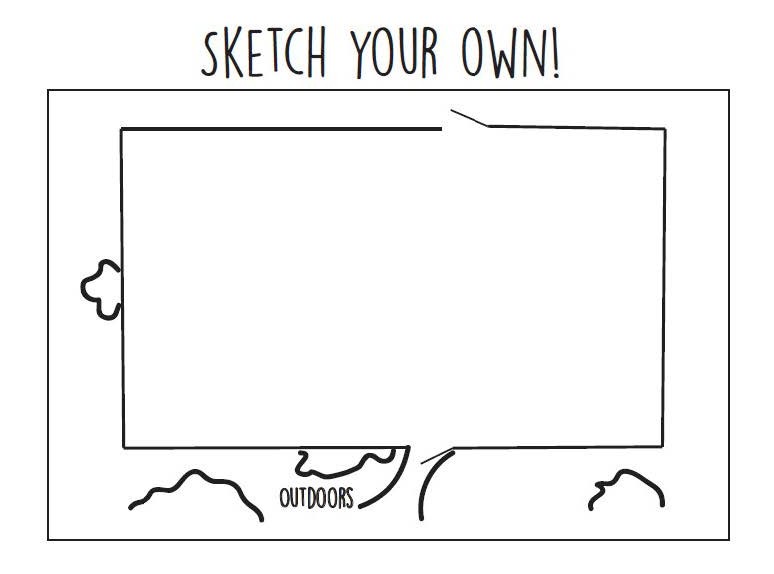
Once you complete your simple illustration, make a note or highlight the top two (2) areas you would like to enhance. Keep the sketch close by, as you will be asked to note ways to improve the areas you have highlighted.
These are the questions you should be asking yourself as you move through the rest of this module:
- Does my learning environment provide enough space for various activities to take place at once without causing stress or competition for space?
- Does my classroom provide a comfortable, cozy, and supportive environment for infants and toddlers to learn?
- Does the classroom setting provide children with opportunities to freely explore all the materials in a safe and healthy way?
Enhancing Playspaces
A properly designed learning environment is essential for infant and toddler development. When considering the space and furnishings in an infant or toddler setting, ensure it is neither too crowded nor too open.
Remember that non-mobile infants need protected areas and cannot safely be in a large space with mobile infants. For toddlers, there should be adequate space for push-and-pull toys, block building, jumping, and, of course, a cozy area.
Also, look at your environment to ensure there are proper spaces and furnishings that promote self-help skills, such as step stools, child-sized furniture, and low shelving.
Remember: A well-organized classroom design should allow for quiet or active play and provide well-equipped interest areas with enough hands-on, age-appropriate materials to prevent conflicts from arising. This type of environment supports and contributes to the overall quality of the program.
Revisiting your Sketch
Take a look at the classroom sketch you made earlier, review the areas you highlighted, and note what you would like to change.
- Does my learning environment provide enough space for various activities to take place at once without causing stress or competition for space?
- Is the room cluttered or disorganized?
- Are the materials within reach for the child?
- Is there ample room for infants to work on motor skills, such as rolling and crawling
Mobile infants and young toddlers are able to explore and learn when their environment is well organized and the materials they need are within reach.
- Does my classroom provide a comfortable, cozy, and supportive environment for infants and toddlers to learn?
- Do you offer a soft place for children?
Cozy areas can be designed with thick mats covered in soft fabric or oversized padded rugs. Provide plush dolls, stuffed animals, and large pillows. Place cozy areas in a quiet corner of the classroom, away from active centers such as the block area or music area, and in clear view for appropriate supervision.
- Does the classroom setting provide children with opportunities to freely explore all the materials in a safe and healthy way?
Meaningful Play Experiences
The classroom design sets the baseline for a supportive learning environment. Embedding activities and meaningful play experiences for children is the next step toward encouraging and promoting quality practices.
For infants and toddlers, play is instrumental in their early years of development. At birth, infants begin to use their hands to explore their own bodies and the world around them. Understanding basic child development and the expectations for this age group helps you choose materials and activities that meet each child’s unique needs and interests. As infants mature into toddlerhood, their skills develop. The more they learn to do with their hands, the more resilient these skills become.
As we strive to offer a variety of materials that capture the interest of infants and toddlers, selecting them can be a challenge for even the most seasoned professionals.
The role of the Teacher is to provide children with a variety of choices in their areas of interest, such as blocks, books, music, movement, and housekeeping. In this segment, examine several different areas of interest that foster learning opportunities through play.
Learning Through Play
Research continues to suggest that children at any age learn best when they are actively engaged with hands-on activities. “Through play, children learn about the world and engage in activities that encourage their cognitive, emotional, and social development” (Elkind 2007).
Creating Cozy Corners
To create an inviting book area, teachers need to offer:
- a comfortable place for children to engage and explore books,
- soft furnishings,
- child accessible bookshelves,
- a selection of sturdy board books, vinyl books, and books with different textures, and
- books that depict a child’s personal daily routine, including families, community, the larger world, and the child’s environment.
Reading has a significant impact on young children’s language skills and emergent literacy. Allowing infants and toddlers to interact with a variety of books and exposing them to words and symbols helps promote and nurture an interest in early literacy development.
Learning to Love Reading
Children do not learn language and literacy in isolation. Therefore, we need to understand how both support and build on one another (ZERO TO THREE, Cradling Literacy, 2007).
Fine Motor Materials
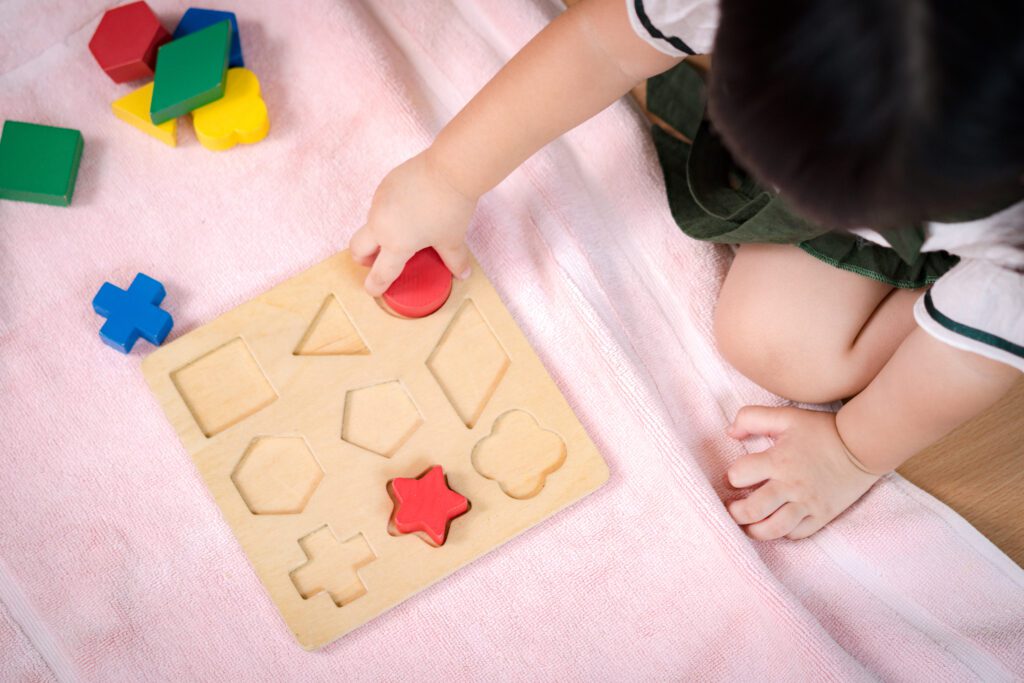
Fine motor skills are the coordination of small muscles, especially in the wrists, hands, and fingers. Fine motor materials, then, are toys and activities that support and engage young children depending on their stage of development. As teachers, we can intentionally select toys that foster curiosity, promote eye-hand coordination, support problem-solving, and develop language skills.
When we offer these resources, we simply provide opportunities for infants and toddlers to use their smaller muscles.
Learning through Music and Movement

To create an interest area that safely exposes very young children to music and movement, teachers should provide a variety of sound-making instruments and props. Teachers need to respond to the child’s need to engage in movement, create, and experience sounds through this form of art.
Not only should music and movement experiences allow for young children’s active participation, but they should also foster opportunities to explore various rhythms, textures, and sounds. Select a variety of sensory play toys, such as instruments, scarves, ribbons, and sound-making toys.
Creating a Construction Zone
Discovery Play
An intentional early childhood teacher follows the children’s interests and leads them on exciting ventures to discover new things, freely explore opportunities, and learn through play. (Bredekamp, 2013).
For infants, providing soft, textured blocks within reach motivates them to use both large and small muscles when grasping for objects. As they grow into the toddler stage, children learn to hold blocks, examine bright colors, and begin carrying toys and objects. Soon, toddlers are learning cause and effect as they fill and dump, stack, knock down, and lay blocks side by side on the floor. Include people, animals, and vehicles alongside building blocks to support and strengthen children’s imaginations.
Enticing Science Exploration
Infants and toddlers use all their senses to discover their world. Offering an interest area specific to nature and science contributes to the development of observation and exploration.
Here are a few ideas for science interest areas:
- Realistic-looking animals,
- Puzzles,
- Sensory bottles,
- Photos of items found in the outdoors (i.e., plants, flowers, and butterflies),
- A birdfeeder close to a window where children can watch and observe,
- Oversized floor puzzles, which create larger-than-life pictures of nature,
- Adding an aquarium or a classroom pet, or
- Plants that are non-poisonous for children.
Nurturing Pretend Play
Whether in a family-certified home or a licensed program, a Dramatic Play center is common in any early childhood setting. When we provide dolls, dress-up clothes, pots and pans, soft animals, and toy telephones, we help very young children make sense of their world.
Sensing the Arts
A prepared art area, complete with tools and activities, allows young children the freedom to manipulate open-ended materials and explore and experiment safely.
Teachers should offer:
- jumbo crayons or markers to use on large pieces of paper,
- chubby paint brushes to use with watercolors, or
- soft playdough with modeling tools for molding and manipulating.
Establishing Routines and Transitions
Teachers need to be aware of the importance of providing daily routines and transitions in the infant and toddler setting. As teachers, when we establish consistent routines, we are simply providing guidance and instruction. Routines are key when ensuring the safety and security of young children. Further, these practices help to reinforce positive behavior.
A daily schedule is a written plan that includes learning activities, play experiences, personal routines, and transitions. Teachers need to provide transitions between these daily events. Implementing smooth transitions lessens the negative impact of moving from one event to another within the schedule. These familiar patterns help infants and toddlers know what to expect and when.
Confidence and Control
Stable routines allow babies and toddlers to anticipate what will happen next. This gives young children confidence, and a sense of control of their environment (ZERO TO THREE, 2010).
Try these activities during transitions:
- Finger Plays
- Countdown Songs
- Puppets
Learning to Trust
Early attachment in relationships significantly affects the development of the whole child (ZERO TO THREE, 2000).
Schedules provide the framework for the day. It is the ritual of a routine that allows for teachable moments with young children. Routines help to establish positive, healthy relationships and build trust between the child and caregiver.
When teachers are involved in children’s routines and play experiences, they help them make sense of their world and foster a sense of discovery. When we set the stage for learning by establishing a developmentally appropriate environment and play experiences, providing consistent routines and smooth transitions, and taking advantage of teachable moments, young children reap the benefits.
Summary and Wrap-Up
If you would like free technical assistance with your room arrangement, contact your Child Care Aware Quality Coach. If you have any further questions about this online module or course credit, contact Inspire Learning Hub.
Resources
Join the Division of Child Care (DCC) mailing list to receive DCC updates, the ECE Insider Newsletter, tips, articles, and tools for Providers.
Send your name and preferred email to:
DCCListServ@ky.gov
Safe Babies is a resource newsletter from Zero to Three. Each quarterly newsletter offers science-based information for encouraging the transition from child welfare to child and family well-being. Subscribe to the Safe Babies newsletter on the Zero to Three website.
The mission of the National Association for the Education of Young Children (NAEYC) is to promote high-quality child learning by connecting practice, policy, and research. Their website is a treasure trove of resources for early childhood educators. They offer multiple newsletters, magazines, and other resources. Visit the NAEYC website and explore all the information and resources available.
The Sesame Workshop has been at the forefront of child development for more than 50 years. The Sesame Workshop website offers resources on a wide range of topics for educators and parents alike, helping preschoolers learn and grow and providing important early education on screens, in classrooms, and in communities.
References
- Copple, Carol, Sue Bredekamp, Derry Gosselin Koralek, and Kathy Charner. Developmentally Appropriate Practice: Focus on Infants and Toddlers. Washington, D.C.: National Association for the Education of Young Children, 2013.
- Cryer, Debby, Thelma Harms, and Cathy Riley. All About the ITERS-R. New York: Teachers College, 2003.
- Curtis, Deb, and Marg Carter. DESIGNS for Living and Learning: Transforming Early Childhood Environments. St. Paul: Redleaf, 2003.
- Curtis, Deb, and Margie Carter. Learning Together with Young Children: A Curriculum Framework for Reflective Teachers. St. Paul, MN: Redleaf, 2017.
- Guyton, G. (2011). Using Toys to Support Infant-Toddler Learning and Development. Young Children, 66(5), 50-56. Retrieved from https://educate.bankstreet.edu/cgi/viewcontent.cgi?article=1006&context=faculty-staff.
- Kostelnik, Marjorie J., Anne Keil. Soderman, and Alice Phipps. Developmentally Appropriate Curriculum: Best Practices in Early Childhood Education. Upper Saddle River, NJ: Pearson/Merrill Prentice Hall, 2007.
- Luckenbill, Julia. “12 Ways to Support Language Development for Infants and Toddlers”. NAEYC For Families. Web. Retrieved from https://www.naeyc.org/our-work/families/support-language-development-infants-and-toddlers.
- Rous, B., Howard, M., Chance, L., DeJohn, M., & Hoover, D. (2011; 2008). Overview of Kentucky’s professional development framework. Lexington, KY: University of Kentucky, Kentucky Partnership for Early Childhood Services.
- Rous, B. & Townley, K. (Eds.). (2006, 2013). Building a strong foundation for school success:
Kentucky’s early childhood continuous assessment guide. Frankfort, KY: Kentucky Department of Education. - “Tips on Playing with Babies and Toddlers”. ZERO TO THREE. Web. April 2016. Retrieved from https://www.zerotothree.org/resource/tips-on-playing-with-babies-and-toddlers/.