
Objectives
- Design an action plan using at least one resource.
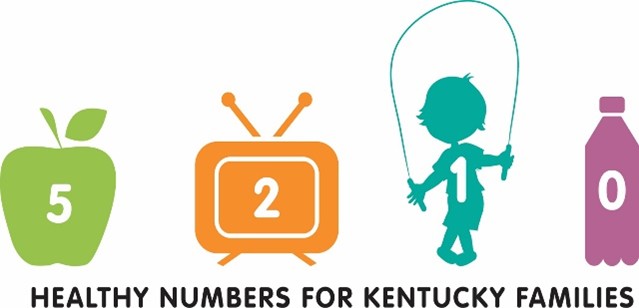
- Describe the 5-2-1-0 healthy behaviors.
- Review the toolkit resources for family engagement and classroom use.
Definitions
Honor a special day or event.
A food used to encourage good behavior.
Water, fruits, vegetables, whole grain foods, protein sources such as eggs, beans, dairy, fish, and poultry, and healthy fats such as nuts, seeds, and avocados.
Any movement that increases heart rate and breathing, such as running, climbing, jumping, dancing, etc.
TVs, computers, video games, tablets, and smartphones.
Any drink that has sugar added to it, including soda, sports drinks, energy drinks, lemonade, and sweetened coffee or tea drinks.
Are foods and drinks high in sugar and/or salt, such as soda, candy, cookies, cake, and chips.
Health and School Readines
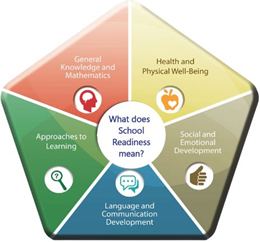
Kentucky’s School Readiness consists of 5 equally important domains.
- General Knowledge and Mathematics
- Health and Physical Well-Being
- Social and Emotional Development
- Language and Communication Development
- Approaches to Learning
The first domain, Health and Physical Well-Being, includes:
- Eats a balanced diet
- Gets plenty of rest
- Receives immunizations
- Receives regular medical and dental care
- runs, jumps, and does other activities
These items directly align with the 5-2-1-0 message. All children deserve to grow up healthy. Health and well-being are important aspects of kindergarten readiness. Traditionally, we associated school readiness with academic and social skills. Research links both nutrition and physical activity to academic and social skills.
5 – Servings of Fruits and Vegetables Daily
Children and adults should consume at least 5 servings of fruit and vegetables daily. Serving size varies by age but is typically the size of a palm. This is true for children as well as adults. As we grow up, our serving sizes increase. Hold out your palm and envision a serving of your favorite vegetable or fruit.
What you say has a huge impact on children and their eating behavior. When encouraging children to try new foods, we want to phrase our suggestions to help them develop healthy eating habits.
Change the way you speak
| Instead of | Try Saying |
|---|---|
| Eat that for me | This is a kiwi, it’s sweet, like a strawberry. |
| If you don’t eat one more bite, I’ll be mad. | This celery is very crunchy. |
| You’re such a big girl; you finished all your peas. | Is your stomach telling you that you’re full? |
| Janice, look at your sister; she at all of her bananas. | Janice, look at your sister; she ate all of her bananas. |
| You have to eat one more bite before you can be finished. | Is your stomach still growling? |
| See, that didn’t taste bad at all, did it? | Did you like that? Which one is your favorite? Everyone likes different foods. |
| No dessert until you eat all of your peas. | Let’s try these carrots another time. Next time, would you like them raw instead of cooked? |
| Stop crying, and I will give you a cookie. | I’m sorry you are sad. Would you like a hug? |
Tips for Families
- Prepare meals and snacks at home using fruits and vegetables.
- Eat together as a family and model healthy eating to your children.
- Offer a variety of fruits, vegetables, and other healthy foods at planned times throughout the day. Let children choose whether and how much they eat.
- Shred or puree fruits and vegetables and use them as ingredients to increase a food’s fruit and vegetable content – try shredded zucchini in breakfast bread or pureed cauliflower in macaroni and cheese.
- Let children help make snacks so they learn how to prepare healthy foods.
2 – Limit Screen Time
Screen time interferes with exploring, playing, and social interaction. Children who spend more time watching TV are more likely to be overweight or obese. Children are watching TV, are not interacting with other children to build social skills, nor are they being physically active. American children and adolescents spend 22-28 hours per week viewing television, more than any other activity except sleeping. By the age of 70, they will have spent 7 to 10 years of their lives watching TV.
Children over the age of two should have two hours or less of screen time, and children under the age of two should have no screen time.
Tips for Families
- Consider having a screen-free home environment.
- Foster children’s love for music and dancing, reading, making art, exploring the outdoors, interacting with others, building, creating, and imagining.
- Remove all screens and electronic devices from bedrooms.
- Turning off electronics during meals and snacks.
- If a screen-free home is not possible, then set and enforce limits (such as times and content).
- Role model appropriate screen time use by limiting personal screen time use.
- Review what your children are watching to ensure the content is age- and family-appropriate.
1 – Get Physically Active
Children should be physically active for at least 1 hour a day. But what exactly does it mean to be physically active? Physical activity can be called breathless play, or moderate-to-vigorous physical activity (MVPA). This would be when a child is playing and they find it hard to breathe. What that rate is will vary for each child. A more sedentary child may be in breathless play much sooner than a more active child.
Physical Activities for Kids
Run or march in place, lifting your knees in front of you as high as you can.
Take a hula hoop and spin it around your waist. Looking for other parts of the body to work on? Use it on your arms or legs.
Do this yoga pose by balancing on one foot. Take your other foot and place it on the inside of your balanced leg. Your knee should be pointing to the side, and your heel should be pointing up your leg. It is okay to leave your toes on the ground if you need to. Bring your hands together in front of you or overhead. Change legs after a count to 30.
Stand with your feet hip distance apart. Squat down with arms extended in front of you. You can have a ball between your hands or just bring your hands together in a fist. As you lower in a squat, bring your hands (with or without the ball) towards the ground. As you rise up, bring your hands (with or without the ball) over your head. Keep your eyes looking straight ahead the entire time.
Stand with your feet and legs together. Keeping your knees together, sit back like you were sitting in a chair. Hold that position as long as you can. Relax when you need to and then try again.
Pretend to ice skate in place as you hop side to side, bringing your heel as high behind you as possible. Swing your arms side to side. You can do this without hopping by stepping to the side and then back.
Place a ladder flat on the ground. Run through the ladder without stepping on the rungs. Pick your knees up high!
Lay cones on the ground in a line to serve as hurdles. Step or jump over the hurdles.
Place a ball between your hands, elbows pointing out to the side. Squeeze your palms in towards the ball. Feel your arms working hard!
Use a real jump rope or pretend to have one. Vary the way you jump – forward, backwards, one foot or two feet.
Extend your arms overhead. Lock your thumbs together. Lift one knee up as you pull your arms down to touch that knee. Arms go back overhead as the foot returns to the ground. Lift the other knee as you pull your arms down to touch the knee.
Physical Activities Clubs
Make a commitment to walk for a period of time every Monday for the entire school year.
Keep track of steps using pedometers and record steps on a chart or incorporate them into a mathematics lesson; grades 2 and up really enjoy using pedometers.
Choose a month with twenty school days. Map out an area around the school or community that is exactly one mile. Every day for a month, have students walk the mile course. At the end of the month, they will proudly say that they were able to walk twenty miles in twenty days! This is a great activity for the spring.
Tips for Families
- Create spaces where children may play outside in every season! Ensure access to playgrounds, grass fields, and portable equipment, like balls.
- Use activities instead of foods as incentives – a trip to the park, laser tag arena, skating rink, batting cage, or community pool are great alternatives to the ice cream store to celebrate a job well done.
- Walk or bike as a family to get where you’re going.
- Plan activity dates with other families or friends.
- Join in on the fun! Not only does it make you a great role model, but adults need physical activity too!
0 – Zero Sugary Drinks
You would be unlikely to let a child have a Snickers bar, an Almond Joy bar, and seven Pixy Stix as a snack. But if they came with a 20-ounce Coke, you would probably be okay with it. Both options have the same amount of sugar. The final part of the 5-2-1-0 message addresses sugary drinks. Look at the table below for the sugar content in an 8-ounce or one-cup serving of typical beverages.
Tips for Families
- Make water the norm for quenching thirst – drink water when you are thirsty and offer water to thirsty children.
- Ensure that drinking water is easily accessible at all times.
- Nonfat and 1% milk and 100% vegetable juices contain beneficial nutrients and calories – they are healthy foods that promote a nutritious diet; they are not beverages to drink when thirsty.
- Sparkling water, still water with slices of lemon, and fruity-herbal iced teas are fun alternatives to plain water.
10 Strategies for Success
The 10 Strategies for Success are evidence-based and align with national recommendations to increase healthy eating and active living. Programs should create and implement policies around these strategies.
But keep in mind: do not try to make all the changes at once. Start slow with small, easy-to-manage goals.
- Limit unhealthy snacks and celebratory foods; provide healthy alternatives.
- Limit or eliminate sugary drinks; provide water.
- Prohibit using food as a reward.
- Provide opportunities to get physical activity every day.
- Limit recreational screen time.
- Participate in local, state, and national initiatives that support healthy eating and active living.
- Engage community partners to help support healthy eating and active living.
- Partner with and educate families in adopting and maintaining a lifestyle that supports healthy eating and active living.
- Implement a staff wellness program that includes healthy eating and active living.
- Collaborate with Food and Nutrition Programs to offer healthy food and beverage options.
Resources for Early Education Professionals:
5-2-1-0 activity calendar – https://www.chfs.ky.gov/agencies/dph/dpqi/cdpb/hpdocs/5210Calendar.pdf
5-2-1-0 book list – Links into course files – will need to be logged in. https://uk.instructure.com/courses/2121620/files/114165411
Dietary Guidelines for Americans – http://www.choosemyplate.gov/
Fruit and Veggie Tracker – https://www.chfs.ky.gov/agencies/dph/dpqi/cdpb/hpdocs/5210FruitVeggieTracker.pdf
Healthy Kids Healthy Future – https://healthykidshealthyfuture.org/
Repeater Eater Log – https://www.chfs.ky.gov/agencies/dph/dpqi/cdpb/hpdocs/5210RepeaterEater.pdf
Screen Time Log – https://www.chfs.ky.gov/agencies/dph/dpqi/cdpb/hpdocs/5210ScreenTime.pdf
Two Bite Food Club – https://www.fns.usda.gov/tn/two-bite-club
References:
Clearninghouse for Military Family Readiness. (2017, July 11) 5-2-1-0 Healthy Children. https://5210.psu.edu/wp-content/uploads/2018/02/5210toolkit_hc_7-11-17s.pdf
Duchette, R. (N.D.) 5-2-1-0 Toolkit: Resources to Support Health Behaviors for Families. [PowerPoint Slides]. Retrieved April 15, 2025, from https://www.chfs.ky.gov/agencies/dph/dpqi/cdpb/hpdocs/5210Toolkitoptimized.pdfLinks to an external site.
5-2-1-0 Healthy Washoe.(N.D.)K-5 School Toolkit. Let’s Go. Retrieved April 17, 2025 from, https://www.nnph.org/files/cchs/chronic-disease/5210_materials/Full%20K%205%20School%20Toolkit%20v1.pdfLinks to an external site.